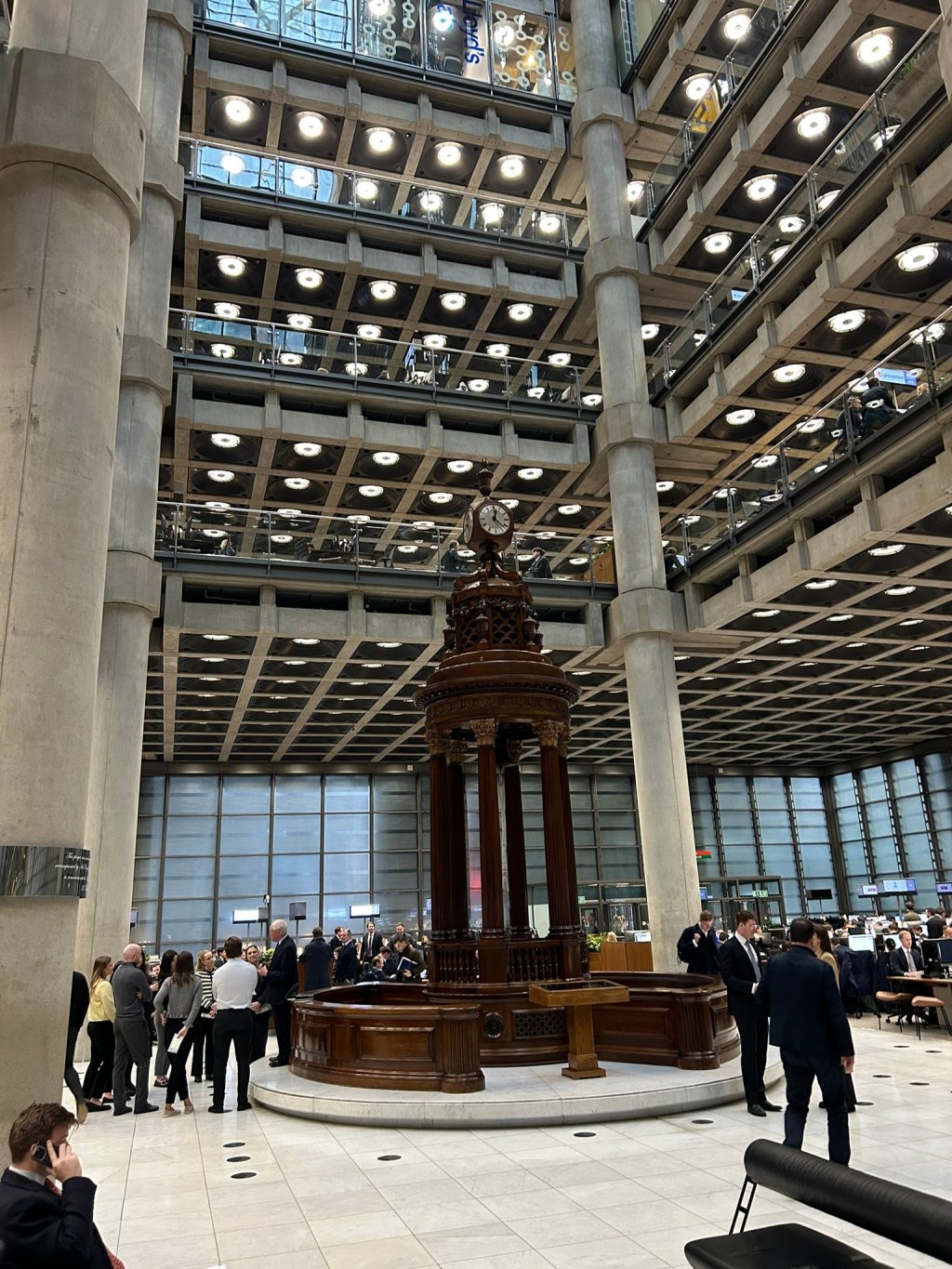
I have identified a problem with these emails.
Everyone in Lloyd’s history is far too nice.
Cuthbert Heath invents things, pays claims and generally behaves like the sort of bloke you’d trust with your house keys. Nicholas Barbon rebuilds London. Underwriters rescue expeditions, rebuild cities and spend several centuries quietly standing behind other people when things go wrong.
It’s all becoming a bit Disney.
We have our goodies. What this story needs is a baddie.
Fortunately for me, in 1923, Stanley Bruce Knowles Harrison absolutely smashed that brief.
Harrison was a Lloyd’s underwriter. His syndicate had five Names and, among other things, had wandered into credit insurance connected with motor-car finance.
Credit insurance itself is perfectly respectable. Indeed, our friend, hero and patron saint of insurance, Cuthbert Heath had helped develop it decades earlier, because Cuthbert spent much of his life coming across things nobody wanted to write and taking it as a personal insult.
The basic idea is straightforward: somebody is owed money, there is a risk that the person who owes it will not pay, and you insure some of that risk.
So far, so insurance.
Harrison, however, found a way to make it considerably more sinister.
He became involved with a company financing cars through bills of exchange. These are basically promises that money would be paid later, which could themselves be sold to finance houses for money now. There were supposed to be genuine transactions underneath all this and, importantly, actual cars.
Sometimes there weren’t.
Quite a lot of the transactions, it eventually emerged, were fictitious.
This is generally considered suboptimal underwriting.
Over roughly two years Harrison’s syndicate guaranteed more than £2 million of these bills. For doing so, his syndicate collected a little over £20,000 in premium, or 1%.
I appreciate that insurance was different a hundred years ago, but even allowing generously for historical context, this appears to be what modern technical pricing experts call quite cheap.
Claims eventually reached about £428,000.
At this point you may be wondering how Lloyd’s auditors had failed to notice that a five-Name syndicate had quietly accumulated an enormous pile of extremely questionable credit exposure.
Good question.
Harrison had two sets of books.
The auditors only saw one of them.
I think we can now safely establish that Stanley Harrison is not Cuthbert Heath.
Eventually the whole thing unravelled and Harrison was left with debts of more than £360,000 which he could not pay. In 1923 that was an enormous sum, but the size of the loss was not really the dangerous bit.
Lloyd’s was still fundamentally a market of individual underwriters. That was the point. Individual people put their individual capital behind risks using their individual judgement. If you were brilliant at underwriting, splendid. If you were terrible at it, eventually this would become apparent, traditionally shortly before you stopped being an underwriter.
Harrison had made the decisions. Harrison had written the business. Harrison had concealed it. Harrison’s name was trashed.
But there was a more important name: Lloyd’s.
The Chairman realised that policyholders did not care about the philosophical distinction between Stanley Harrison and several hundred entirely innocent underwriters elsewhere in The Room.
As far as policyholders were concerned, they had bought a Lloyd’s policy.
If those claims went unpaid, the story outside the market would not be: “A regrettable failure involving the liability of an individual underwriting member.”
It would be much shorter.
Lloyd’s doesn’t pay. That’s heresy in the Church of Lloyd’s. It could not be allowed to happen.
So the market was called together and did something brilliant.
The members agreed unanimously to contribute towards Harrison’s debts according to the amount of premium they wrote. The largest contribution was about £10,000. The smallest was eight pence.
Somewhere in The Room, therefore, was a man who had done absolutely nothing wrong, was presented with a bill for Stanley Harrison’s catastrophic underwriting, contributed eight pence and, if he was anything like me, presumably spent the rest of his life telling people about it (probably over a neighbourhood barbecue in Deal).
They all paid.
Not because Harrison deserved rescuing.
He emphatically didn’t.
They paid because the promise deserved rescuing.
And out of that mess came something enormously important.
Until Harrison, Lloyd’s security was fundamentally individual. The underwriter made the judgement, wrote the risk and stood behind the policy with his own resources. Harrison demonstrated the uncomfortable limit of that idea: however individual the underwriting might be, the reputation attached to a Lloyd’s policy belonged to the whole market.
If one member failed badly enough, everybody else could suffer.
So Lloyd’s changed.
The Harrison affair helped establish the principle of collective security which ultimately developed into the Central Fund we have today: money held behind the market and available when an individual member cannot meet a valid claim.
In other words, Stanley Harrison managed, through an almost heroic combination of crap underwriting, inadequate premium, fictitious transactions and keeping the interesting accounts away from the auditors, to make Lloyd’s safer.
I find that wonderful.
Cuthbert Heath helped build the modern Lloyd’s by showing what brilliant underwriting could achieve.
Stanley Harrison helped build it by demonstrating, with considerable enthusiasm, what happens when underwriting goes catastrophically wrong.
This is Harrison’s accidental contribution to Lloyd’s history:
The signature on a policy might belong to one underwriter. The judgement might belong to one underwriter. The profit or loss might belong to one syndicate.
But the reputation attached to the promise belongs to everyone.
Harrison forgot that.
Lloyd’s didn’t.
So, after several months of Cuthbert Heath being unbearably competent, Sunday Nonsense finally has its first proper sinner.
Stanley Bruce Knowles Harrison.
Please do not be like Stanley.
Have a good week,
Rob


Leave a Reply