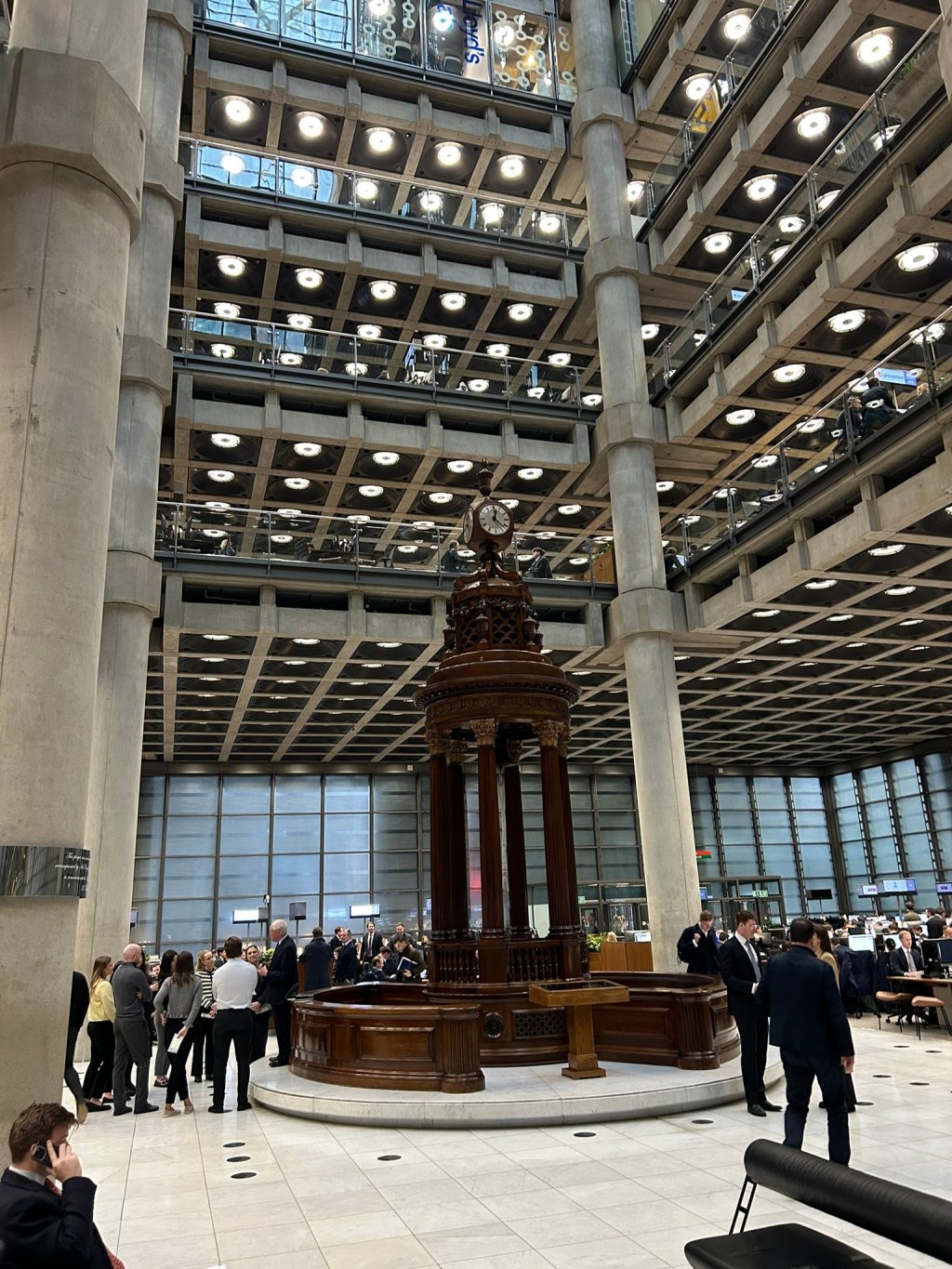
This week, we welcomed three new starters to the team.
Each one joined a Teams call with me.
Each one noticed the photograph of the Room on my living room wall.
Each one asked what it was.
Each one received an answer that was considerably longer than the question deserved.
By the end of the call they knew about Edward Lloyd’s coffee shop. They knew about Cuthbert Heath. They knew why this market exists, and why a man they had known for approximately 24 hours has a framed photograph of an underwriting room hanging in his house.
And I think each one, quietly, but ever so politely, wondered the same thing.
Why that building? Why that photograph?
Let me tell you about one of the many nights and days the building earned it.
The Lloyd’s building opened in 1986. Richard Rogers. All those pipes on the outside, the lifts in glass capsules, the escalators running up the atrium like it was from a science fiction film. The market thought it was extraordinary. The City thought it was showing off. The architectural critics thought it was either genius or an act of considerable nerve, depending on who you asked.
One year later, on the evening of Thursday 15th October 1987, BBC weatherman Michael Fish sat down in front of the nation and delivered the following reassurance.
“Earlier on today, apparently, a woman rang the BBC and said she heard there was a hurricane on the way. Well, if you’re watching, don’t worry. There isn’t one.”
There was.
By 6am the following morning, the worst storm to hit Britain since 1703 had torn through the south of England. Winds of 115mph. Fifteen million trees felled. Power lines down across six counties. Roads impassable. Roofs gone*.
And in every county across southern England, in every house and every office and every farm that had just lost something, the same thought arrived at roughly the same moment.
I need to make a claim.
What followed was unlike anything the insurance industry had ever seen. There were no call centres. There were no surge plans. There were no managed builder networks, no panel loss adjusters on standby, no digital claims systems. There was a telephone, a filing cabinet, and a very large number of people who needed help immediately.
Claims arrived by post. By telephone. In person, at local offices, from people standing in the street with pieces of their roof in their hands.
Not after seventeen emails about the excess.
Not after a digital assessment and a chatbot triage.
Not after a risk management review and a surge capacity activation protocol.
They just showed up. And the market dealt with them.
£1.4 billion in claims. Nearly half of total annual property insurance premiums, paid out from a single night’s work by a storm that nobody saw coming. The industry ran out of filing cabinets. It ran out of claims forms. It ran out, in at least one office, of paper.
But it paid. Every valid claim. Slowly, chaotically, with filing cabinets borrowed from other floors and loss adjusters working seven days a week for months – but it paid.
The building that everyone thought was showing off turned out to be exactly what you need when the world falls apart on a Thursday evening in October.
That’s the photograph on my wall.
Not the architecture. Not the pipes. The market inside it – the one that, when fifteen million trees came down without warning and half of England reached for the telephone at the same time, didn’t flinch.
Our new starters joined a team building tools so that the next time something falls without warning – and something always falls without warning – nobody has to run out of filing cabinets.
That’s what we’re building.
Have a good week.
Rob
P.S. * What does a claims adjustor say to you if you lose 25% of your roof? Oof.
P.P.S. There will be no Sunday Nonsense for the next two weeks. I’m in Morocco on holiday.
See you in a couple of weeks, fans of nonsense.


Leave a comment