On Sunday afternoon I was in the pub with my writing club, attempting to write some nonsense.
One of our members joined us. He had just returned from his honeymoon, which you might assume gave us quite a lot to talk about.
Instead, for reasons I can’t reconstruct, we spent most of the afternoon discussing pies.
Not marriage. Not travel. Not whatever profound romantic wisdom a newly married man is supposed to return from his honeymoon carrying.
Pies.
Good pies. Bad pies. The correct ratio of filling to pastry. Whether a pie with only pastry on top is really a pie, which I appreciate is the sort of question that has toppled friendships.
Then, at some point, he disappeared.
I assumed he had decided there were limits to how much of his first weekend home he was prepared to spend discussing pastry with us.
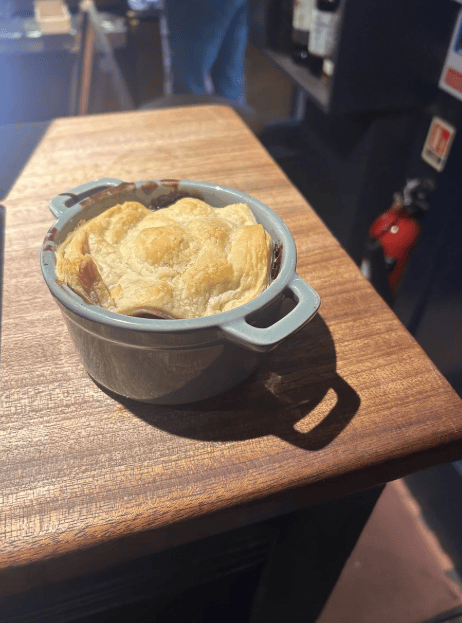
A little while later he came back carrying individual pies, fresh from the oven, for all of our merry little group.
I have no idea whether this was generosity or an attempt to end the conversation by satisfying it.
We had spent a long time discussing a thing. He went and got the thing.
Insurance, it turns out, has occasionally done much the same.
After the Great Fire of London in 1666, people became understandably interested in the possibility that their houses might burn down.
This was not an entirely theoretical concern. London was densely packed, largely built from combustible materials and full of naked flames. Heating, lighting and cooking all involved setting fire to something deliberately and then trusting everyone involved to know when to pack it in.
There was also no public fire brigade. If your house caught fire, the available response consisted largely of neighbours, buckets, hooks, whatever water happened to be nearby and a great deal of shouting.
So fire insurance appeared.
You paid an insurer some money. If your house burned down, the insurer paid you some money. Everyone understood the arrangement.
Then the insurers looked at this for a while and had another idea.
What if we stopped the house burning down?
Admittedly, not a particularly sophisticated piece of actuarial reasoning.
But by the end of the seventeenth century, insurance companies were employing their own firefighters. The Hand in Hand Fire Office started with six men in 1699. Others did much the same. They employed Thames watermen, bought pumps, axes and hooks, and established teams whose job was to turn up when something was on fire and make it a bit less on fire.
Imagine buying home insurance today and discovering that your insurer has not merely agreed to reimburse you if your kitchen burns down, but has stationed thirty muscular men in your kitchen in case the toaster gets frisky. I used to work in home insurance, and it now occurs to me this would have actually been an excellent sales strategy.
The companies put metal fire marks on insured buildings displaying their emblems. You can still spot them high on old buildings around the City. There is a popular story that these marks allowed an insurer’s firemen to arrive at a burning house, inspect the plaque, discover it belonged to a competitor and fold their arms.
Which is an brilliant story. It’s also not true. Fire doesn’t pay much attention to branding, and allowing somebody else’s house to burn unchecked is an absolutely excellent way of discovering that you insure the one next door.
Because the early pumps required teams of people working them continuously, insurers also paid for beer for the pumpers.
This was not an employee engagement initiative. Drinking water was unreliable, pumping was exhausting, and apparently the sensible solution was beer.
I feel some elements of eighteenth-century risk management deserve revisiting.
Eventually there were so many separate brigades that the arrangement became inefficient, so in 1833 ten of them combined to form the London Fire Engine Establishment under James Braidwood.
Braidwood professionalised the whole thing. Training became systematic. Equipment improved. He worked out that you fought a fire from inside the building rather than from a safe distance outside it, which saved a great many buildings and was, as approaches go, considerably more dangerous for the men doing it.
Firefighting stopped being something brave men did while standing unusually close to flames, and became something people studied.
In June 1861, a fire broke out in a warehouse at Tooley Street. Braidwood was there, doing what he had spent thirty years telling his men to do, and a wall came down on him.
The fire burned for a fortnight. His funeral procession was a mile and a half long, and London stopped to watch it pass.
The organisation he built eventually gave rise to the London Fire Brigade we have today.
Which means there is direct lineage from people buying insurance after the Great Fire of London to the fire engine that turns up when somebody calls 999. I love how many heroes there are in our market.
Insurance didn’t invent fire, and it certainly didn’t invent the human instinct to run towards a burning building carrying water.
Insurers have never much wanted to pay for a burnt down house. Not because we won’t pay a valid claim, which would be heresy in the Cathedral to insurance. But because we’d far rather the house still existed.
So insurers stopped discussing what a fire might cost and started hiring people who could put one out.
There is a tendency to describe insurance as though its purpose begins after something has gone wrong. A storm happens. A building burns. A ship sinks. A claim arrives. Then insurance does its bit.
But the history of this market is full of moments where somebody looked at that arrangement and decided paying for the consequences was not quite enough.
The best claim is the one nobody ever needs to make.
And sometimes, after a long enough discussion about the problem, somebody simply needs to disappear for a bit and come back carrying the answer.
So for me on Sunday, the answer contained steak and gravy.
In seventeenth-century London, it was six men with buckets.
The principle is much the same.
Have a good week,
Rob
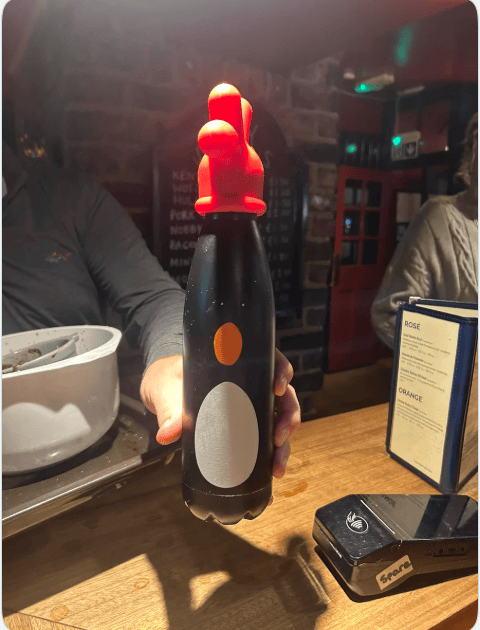
P.S. This is the thermos that contained the gravy. We call him Feathers McGravy, which might explain a lot about these emails.
P.P.S. I’d love to pretend the fire extinguisher in the background was a very clever in-joke on a piece about fire insurance – no, you know what, I’m going to run with it. Entirely deliberate.


Leave a comment