I have some rather disturbing news.
Those of you who have been reading the Nonsense for a while will know that I have a certain affection for Lloyd’s and our market. I appreciate that describing it as an affection is rather like describing the Pope as being moderately interested in Catholicism, but as you know, I try not to make a fuss.
As some of you also know, I occasionally take people on tours of the building. I have a route.
We start in the basement, visit the Nelson collection and the Old Library, go into The Room to see the Loss Book and the Lutine Bell, stop on G2 for a brief explanation of “Recruit to Dilute“, head up to G3 for the exhibition of Lloyd’s medals, G7 for the artwork, then the executive suite, Sir David Rowland’s dining room, the Adam Room, more artwork, back down to the Room, into the coffee shop, and finally a stop to pay my respects to Geoff, who taught me so much about this extraordinary place.
We leave through the gift shop, by which point my guests have either fallen in love with Lloyd’s or are considering calling the police.
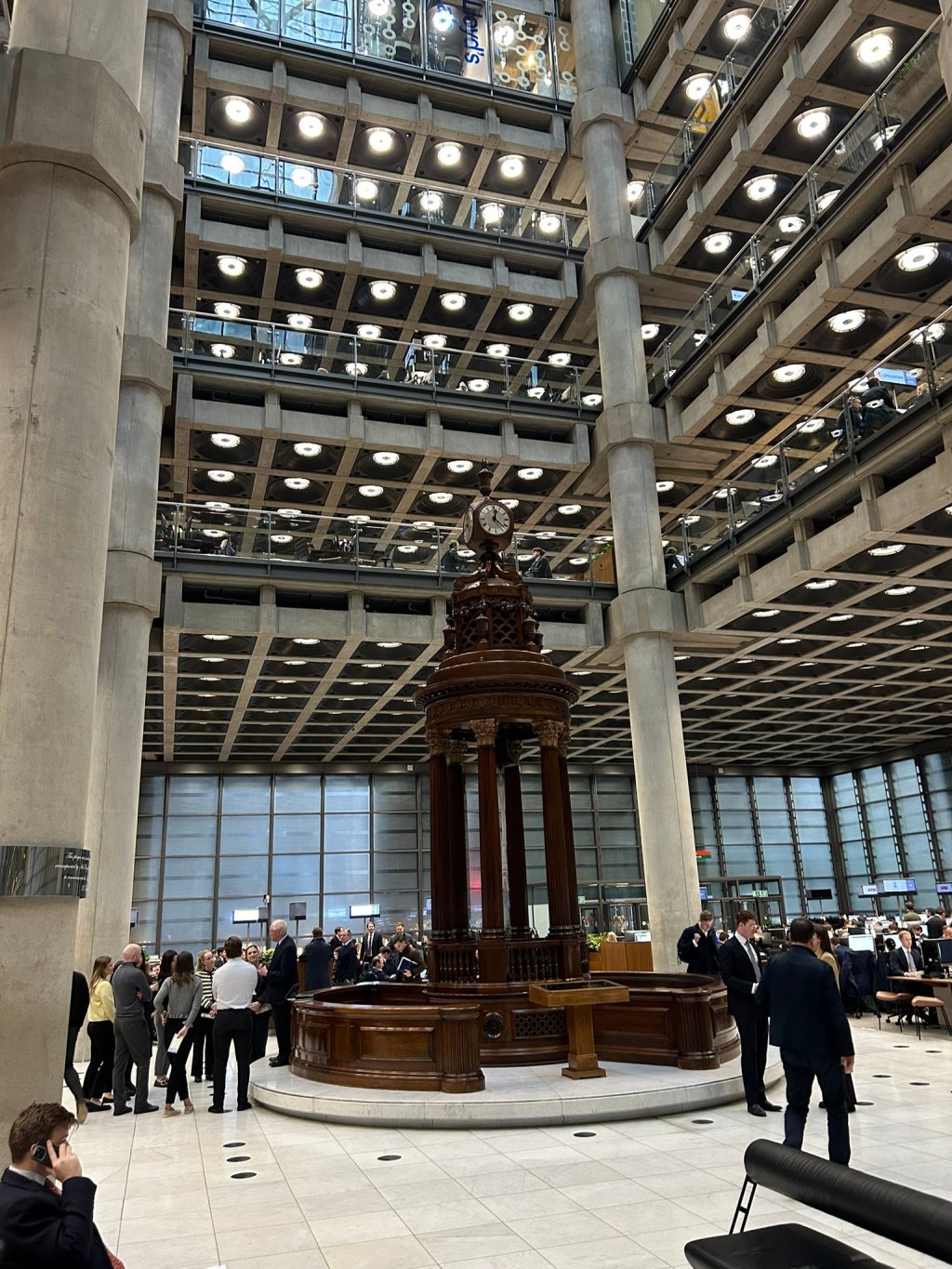
I know the building. I know its history. I know the stories behind things most people walk past without noticing. And at the very heart of the Room, hanging beneath the Rostrum, is the Lutine Bell.
The most sacred relic in my cathedral.
Or so I thought.
Because this week I discovered something that has shaken me to my very foundations.
THE LUTINE BELL MIGHT NOT ORIGINALLY HAVE BELONGED TO THE LUTINE.
I appreciate that some of you may consider this a fairly minor historical curiosity. You are, of course, entitled to your opinion, however spectacularly wrong it may be.
For those of us who regard Lloyd’s with something approaching religious reverence, this is a theological crisis of considerable magnitude.
Imagine discovering that the Crown Jewels came from Argos.
That is where I am emotionally.
The story, as we know, begins in October 1799, when HMS Lutine sank off the Dutch coast, taking almost everyone aboard and an enormous cargo of gold and silver with her. The cargo was insured at Lloyd’s, and the claim was paid. In 1858, salvagers recovered the bell from the wreck, and it eventually took its place at the heart of our market.
Except there is a problem.
The bell doesn’t say Lutine.
It says ST. JEAN, 1779.
There are several theories. One is that the ship was originally intended to have a different name. Another, rather more disturbing, is that the bell came from an entirely different French vessel and was fitted to HMS Lutine when the British refitted her after her capture.
Nobody knows.
I went into the Room this week and asked the Head Waiter and Deputy Head Waiter whether they’d ever heard this story.
Neither had.
Given that they spend considerably more time in the Room than I do, I found this simultaneously reassuring and alarming.
We are an industry whose entire existence depends upon identifying risks, establishing facts, scrutinising evidence and asking awkward questions, and I have spent decades conducting people past the most famous object in Lloyd’s without undertaking the most elementary due diligence.
The evidence has literally been engraved on the thing since 1779.
I am considering reporting myself to Compliance.
But while attempting to recover from this catastrophic collapse of everything I hold dear, I found myself thinking about why the bell matters quite so much.
For generations, it was used to announce the fate of overdue ships. One ring meant a ship had been lost. Two meant she had arrived safely.
Imagine standing in The Room a century ago, hearing that sound and knowing that somewhere, perhaps thousands of miles away, somebody was about to receive news that would change their life.
The bell could tell you whether a ship had been lost. It couldn’t tell you what happened to the people aboard.
Which brings us to January 1926.
The Antinoe was a British cargo ship crossing the Atlantic when she encountered a ferocious winter storm. Her steering was destroyed, water flooded her machinery, and her lifeboats were swept away. Hundreds of miles from land, she was helpless.
Her distress call was answered by an American passenger liner, the President Roosevelt, commanded by Captain George Fried.
Fried found her pitching in seas so violent that launching a lifeboat seemed almost impossible.
But the men aboard the President Roosevelt volunteered to try.
During the first attempt, the lifeboat was smashed against the side of the ship. Two sailors, Uno Wirtanen and Ernest Heitman, were thrown into the freezing Atlantic.
A fellow crewman, John Hahn, described desperately trying to pull one of them back aboard. He threw him a rope. The man caught it. They began hauling him out of the water, but his grip failed and he fell back into the sea.
They searched for hours.
Neither man was found.
Now, I think we would have understood if Captain Fried had called off the rescue. Two of his own men had died trying to save strangers, and he was responsible for hundreds of passengers aboard his own ship.
But Fried refused to leave.
He stayed alongside the Antinoe, trying again and again as the storm raged, losing lifeboats and equipment.
Eventually, another call went out for volunteers.
And they stepped forward again.
Among them was our new friend, John Hahn, who had just watched his shipmates disappear into the sea.
While he waited for a break in the weather, a minister prayed for him.
A priest gave him the Last Rites.
The passengers offered him cigarettes.
Lots of cigarettes.
Hahn accepted every one.
After five hours, he had accumulated fourteen packets of cigarettes.
One small problem: he didn’t smoke.
He later explained that he couldn’t bear to refuse such kindness, and his little white lie had got rather out of hand.
Even while preparing to risk his life, somebody had managed to create a completely unnecessary social predicament.
Eventually, the weather eased just enough for the lifeboats to try again.
Hahn and the other volunteers rowed into mountainous seas, narrowly avoiding being crushed against the stricken vessel. Across three perilous journeys, they brought twenty-five men to safety.
By the end of the operation, every member of the Antinoe‘s crew had been saved.
When the last of Hahn’s party climbed back aboard, a cheer went up. But in his account of that moment, he wrote something in his diary I love:
“I could not help but think of the men we did not bring back.”
The rescuers were celebrated on both sides of the Atlantic.
And Lloyd’s awarded its Medal for Saving Life at Sea to members of the President Roosevelt‘s crew.
One recipient was a fireman named Frank Roberts. His medal survives today, engraved with his name and the dates of the rescue. On the reverse are three words I love:
PRESENTED BY LLOYD’S.
These men weren’t underwriters, or anything to do with our market really, but the market still felt their heroism needed recognising.
When the ship eventually returned to New York, crowds welcomed the men as heroes. Bands played, ships sounded their horns, and Captain Fried was reunited with his wife.
But down in the captain’s cabin were two medals awarded by the British government that nobody would ever wear.
One for Uno Wirtanen.
One for Ernest Heitman.
Two extraordinary men.
They weren’t attempting to save their own ship. They weren’t protecting their cargo or fulfilling an obligation.
They were trying to save people they had never met.
But somebody needed help.
And they went.
Which brings me back to the Lutine Bell.
For years, I’ve taken visitors past the bell, explaining the wreck, the gold and the salvage, before taking them upstairs to G3 to see the collection of medals.
It has taken me until this week to realise that I have been telling them the same story twice.
The bell reminds us of ships lost and ships brought safely home. The medals remind us of the people prepared to risk everything, even their lives, to bring others home.
I started this week worrying that the most sacred object in the Room might have somebody else’s name written on it.
I finish it thinking about two names I had never known.
Uno Wirtanen and Ernest Heitman.
Twenty-five men were saved because Captain Fried and his crew refused to abandon them. Two men gave their lives trying.
One ring for those who never came home.
Two for those who did.
Whatever name that bell carried before it came to Lloyd’s, I cannot think of a more fitting place for it to spend the rest of its life.
Have a good week,
Rob
P.S. There is a mystery still unresolved. Sources are divided as to if the bell says ST. JEAN or SAINT JEAN. The liveried waiters in The Room have said it’s due for a polish so they’ll pop the up the rostrum and let me know.


Leave a Reply