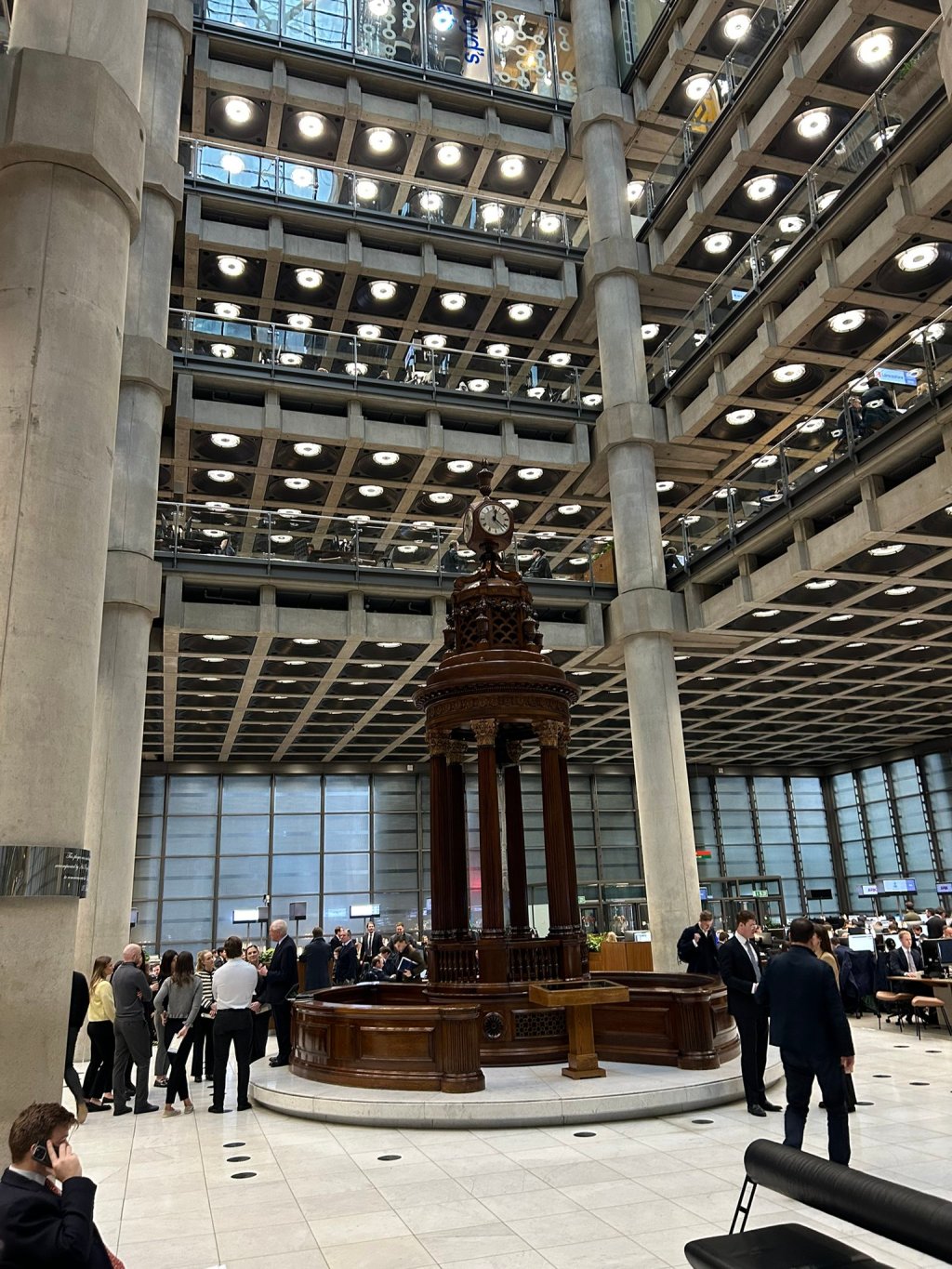
I’ve worked in insurance for a very long time, and not once has an underwriter offered me a blanket.
This seems an oversight. We spend our entire professional lives promising people cover, and an astonishing amount of paperwork establishing precisely what that word means.
And this week, I found out that we once provided the real thing.
Proper cover. The sort with a roof.
When Britain entered the Second World War in September 1939, the Lloyd’s market faced a rather significant operational difficulty. There was every possibility the Luftwaffe would develop something of a penchant for dropping explosives on London, and there were concerns that this might interfere with the underwriting process.
Somebody sensibly suggested moving things underground.
The basements of the old 1928 Lloyd’s building in Leadenhall were reinforced with heavy timbers and steel, and a principal air-raid shelter was established beneath the neighbouring Royal Mail House, where the Willis building stands today.
There are photographs of it all on G7 at Lloyd’s, and if you’re unlucky enough to come on a tour with me, I can show you where to look.
Nearly 500 staff were relocated to offices at Pinewood Film Studios in Buckinghamshire. I have always thought insurance could benefit from a little more glamour, but sending the administration department to a film studio seems an ambitious way of achieving it, even to me.
The underwriters, naturally, carried on underwriting.
There are wonderful accounts of the market operating from its underground shelter, with underwriters occupying marked positions so brokers could find them. Apparently, even the possibility of being bombed was no reason to abandon the seating arrangements, in much the same way my office operates a hot desk policy which we all accept, while acknowledging that this desk is my hot desk.
Food and cigarettes were available, along with haircuts and even theatre tickets.
I rather love this. London was under attack, the country was fighting for its survival, and somebody in the Lloyd’s market had remembered that gentlemen might require a little trim from time to time. In fact, the barber’s was so popular that it survived until around 2015, and was most useful if you fancied a little afternoon nap, or so I’m reliably informed, by myself.
Business continued much as normal.
But that’s not the wonderful part of this story.
To understand that, we need to leave the City and travel a few miles east.
On 7 September 1940, the Luftwaffe began its sustained bombing campaign against London. The East End, with its docks, warehouses and densely populated streets, suffered terribly.
Every evening brought the possibility that an aircraft overhead might destroy your home. Families carried bedding and whatever belongings they could manage, searching for somewhere safer to spend the night. Some slept in Underground stations. Others sheltered beneath churches, shops or railway arches.
And when morning came, they went back to find out what remained.
Night after night, never knowing whether you’d sleep, whether your home would survive, or whether the people you loved would still be there in the morning.
From October 1940 until May 1941, the Lloyd’s building itself provided ongoing shelter for approximately 170 people from London’s East End.
Not underwriters. Not brokers. Not people bringing risks into the Room.
Ordinary Londoners whose homes and neighbourhoods had become desperately dangerous places to be.
Our market opened its doors to them.
I don’t know their names. I’ve tried to discover who they were, and so far I can’t find them.
I’d love to know whether, after weeks of fear and uncertainty, they finally felt able to close their eyes without worrying quite so much about what might happen next.
For centuries, Lloyd’s had helped people recover from disaster. When ships were lost, when buildings burned, the market existed to help people put things back together.
But in 1940, there were people who couldn’t wait until after the disaster.
They needed protection now.
Not a promise written on a slip. A roof. Reinforced walls. A door that opened.
They brought their own blankets.
And for eight months, we provided the cover.
Have a good week,
Rob
P.S. Under better circumstances, as I think we all know, I would absolutely love to spend the night camping in The Room.


Leave a Reply